
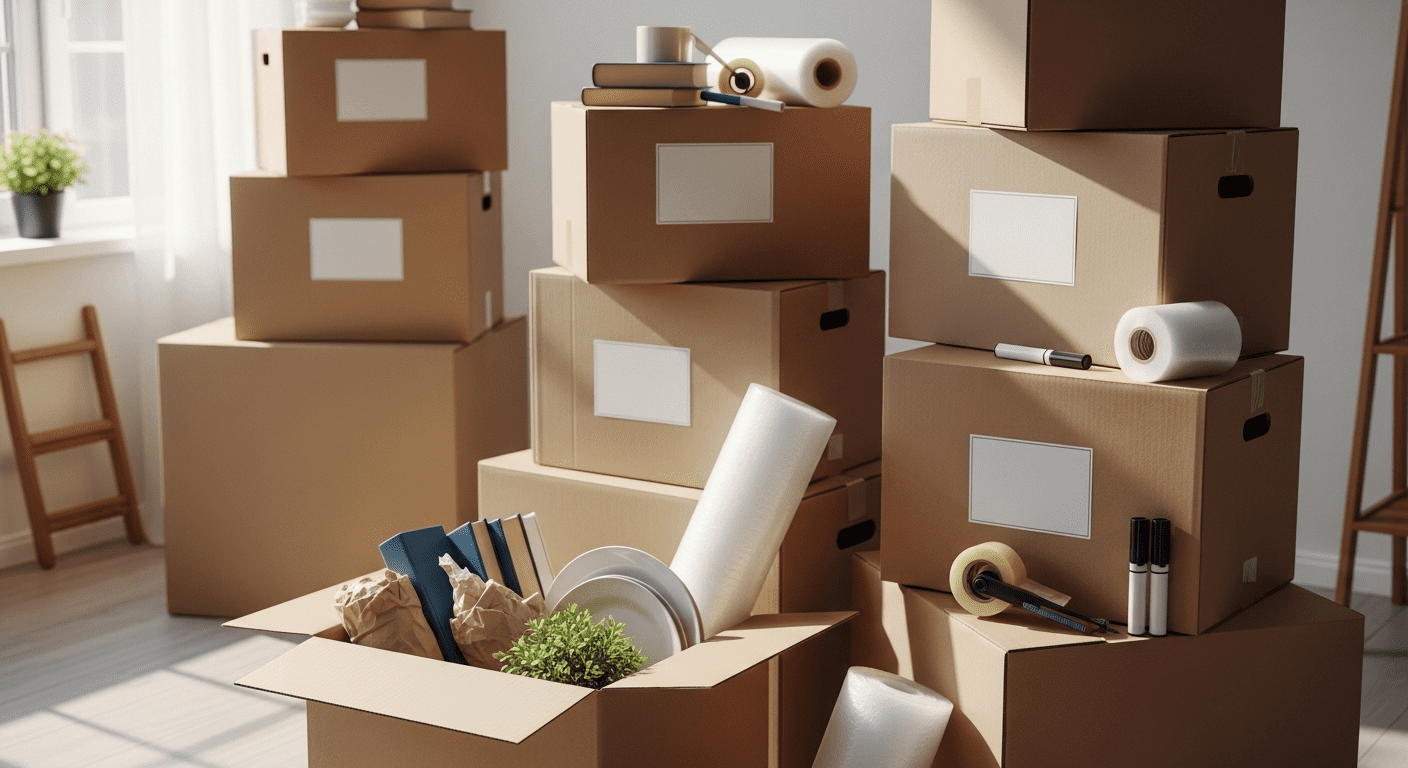
What actually happens after the box is closed?
Once the lid is taped shut, your belongings begin a completely different journey. Every lift, step across the driveway, speed bump, sharp turn, and box stacked on top creates forces inside the carton that most people never see. A well-packed box does not simply sit still until it arrives. It continuously absorbs pressure, movement, vibration, and changes in weight.
Understanding these hidden forces helps explain how boxes protect items during moving and why professional movers choose strong, purpose-made removal boxes instead of thin or damaged supermarket cartons. More importantly, it shows how the right box can reduce damage before the removal van even leaves your driveway.
Quick answer: A moving box protects its contents by spreading pressure through its walls and corners, limiting internal movement, absorbing small impacts, and helping items remain stable during lifting, stacking, and transport.
A Moving Box Is More Than Just Cardboard
Many people see a moving box as a simple container. In reality, it is a protective structure designed to spread weight, absorb impacts, and keep household items stable while they are being moved.
A moving box works a little like a car’s suspension. When everything is working correctly, you hardly notice it, but it is constantly absorbing shocks to protect what is inside. A good removal box spreads pressure across its walls and corners instead of allowing it to build up against one fragile item.
This is why double-wall cardboard boxes made for moving generally perform better than thin, reused cartons. They are built to retain their shape and support loads from several directions.
The Journey Starts Before the Van Moves
Most people assume that damage happens during the drive. In reality, many problems begin much earlier.
As soon as someone lifts a packed box, gravity starts acting on everything inside. If the weight is not balanced, heavier items move towards one side. Even a short walk from the hallway to the van creates small movements inside the carton.
Professional movers can often tell whether a box has been packed properly simply by lifting it. A balanced box feels stable and predictable. An uneven one twists in the hands, is harder to carry, and places more stress on both the cardboard and the items inside.
Hidden Force #1: Compression
Compression is one of the most important forces affecting belongings during a move. Put simply, compression is weight pressing down.
Imagine placing one packed box on top of another. The bottom box immediately starts supporting the full weight of the carton above it. Add three or four more boxes, and the lowest box may be carrying many times the weight of its own contents.
If the cardboard is strong, much of this moving box pressure travels safely through the vertical corners. If the cardboard is weak, damaged, or softened by moisture, the side panels begin to flex inward.
At first, the box may still look normal. Inside, however, pressure can gradually transfer onto plates, picture frames, electronics, or decorative items. Belongings that were carefully wrapped may begin carrying part of the load themselves.
This is one reason boxes can appear undamaged on the outside while fragile items inside are cracked or crushed.
Why the Corners Matter Most
The four vertical corners are among the strongest parts of a well-made moving box.
Think of the pillars supporting a bridge. The structure does not rely on the middle of the road for support; it depends on the columns beneath it. Cardboard boxes work in a similar way.
When boxes are stacked correctly, the corners transfer much of the load towards the floor. If those corners become crushed during loading, the box loses a significant amount of its structural strength.
This is why professional movers avoid dragging boxes over rough concrete or dropping them onto one corner.
Hidden Force #2: Weight Transfer
Weight transfer is another force that is easy to overlook.
Inside every moving box, heavier items naturally shift towards the lowest point whenever the box changes direction.
Imagine packing several hardback books beside lightweight photo frames. When the person carrying the box turns a corner, the books continue moving for a fraction of a second because of momentum. That small movement pushes against the side of the box and places extra pressure on nearby items.
Now imagine this happening repeatedly throughout an entire house move.
Each small movement gradually alters the balance inside the box. Eventually, heavier objects can start pressing directly against the cardboard instead of remaining supported by packing paper.
Professional packers reduce this risk by placing heavy items at the bottom, distributing weight evenly, and filling empty gaps so the contents cannot move freely.
Why Empty Space Can Cause More Damage Than Weight
Many people leave small gaps inside boxes because they believe belongings need extra room. In practice, empty space is one of the main reasons items are damaged during transport.
Picture a wine glass inside a box with several centimetres of unused space around it. As the van moves, the glass can slide into that gap and then stop suddenly against the side of the carton.
Each movement may be small, but repeated impacts can weaken fragile items. One bump may not cause damage; hundreds of small knocks during a long journey can.
That is why professional movers use packing paper for more than wrapping. They also use it to lock everything in position so the contents behave more like one stable unit than several loose objects.
Hidden Force #3: Vibration
Not every threat comes from a major impact. Thousands of small vibrations can cause just as much damage over time.
- Walking across a driveway
- Rolling a trolley over paving
- Driving on rough roads
- Crossing speed bumps
- Stopping at traffic lights
Each action sends small vibrations through the cardboard and into the contents.
Unlike a single bump, vibration happens continuously. During a two-hour journey, a box may experience thousands of tiny movements. These vibrations can loosen wrapping, increase friction between items, and encourage heavier objects to shift.
This is one reason the strongest moving boxes are made to resist repeated movement rather than merely hold weight while standing still.
Hidden Force #4: What Happens While the Van Is Moving?
Once boxes are loaded into the van, they face a new combination of forces. Even on a smooth road, the vehicle is continually speeding up, slowing down, turning, and reacting to changes in the road surface.
Cardboard cartons are often much lighter than the objects they contain. When the box changes direction, the contents may continue moving for a fraction of a second. This is why good packing and secure vehicle loading must work together.
Road Bumps: Small Obstacles, Big Effects
Most people worry about major accidents, but ordinary road conditions are much more common. Speed bumps, potholes, uneven roads, and kerbs all create brief jolts.
When the van hits a bump, its suspension absorbs much of the shock, but not all of it. The remaining force travels through the vehicle floor and into the stacked boxes.
A well-packed carton spreads that force across its base and corners. A poorly packed one allows items to bounce independently. Glassware may knock against neighbouring pieces, books can shift, and decorative objects may slowly move out of position.
One bump rarely causes all the damage. Repeated bumps over a longer journey can.
Braking Creates More Force Than You Think
As a van travels forward, the box and its contents move at the same speed. When the driver brakes, the vehicle slows down, but the objects inside naturally want to continue moving. This is inertia: an object continues in motion until another force stops it.
Even gentle braking can make heavy items press against the front wall of the box. If there is empty space, those objects may slide before stopping, increasing the impact.
Heavy belongings should therefore be placed low in the box and surrounded with cushioning that prevents movement.
Turning Corners and Roundabouts
When a vehicle turns, the contents inside a box tend to continue travelling in a straight line. This produces sideways pressure against one panel.
Imagine a box containing books and a framed picture. The books are heavier, so they move first. If the frame is beside them without enough protection, repeated sideways pressure can crack the glass even when the box has never been dropped.
Professional movers reduce this risk by loading heavier boxes tightly together so they support one another and are less likely to slide across the vehicle floor.
Box Flexing: The Silent Cause of Damage
Cardboard may appear rigid, but every box flexes slightly during lifting, stacking, and transport.
Strong double-wall boxes resist this movement better than thin cartons. Excessive flexing changes the shape of the box and transfers stress to the contents. A ceramic bowl that was safely positioned in the centre may press against another object when the base bows.
This is another reason belongings can break even when the outside of the box looks fine.
Moisture Is an Invisible Enemy
Most people focus on impact damage, but moisture can be just as destructive.
Cardboard is made from paper fibres, and these fibres lose strength when they absorb water. A damp garage floor, light rain during loading, or condensation inside a vehicle can weaken a box before it looks obviously wet.
As the cardboard softens, the sides become easier to bend and the base may sag under weight. Packing tape also adheres less effectively to damp surfaces, increasing the chance of seams opening during transport.
Important: Keep packed boxes off wet floors and protect them quickly during rainy weather. Even minor moisture exposure can reduce stacking strength.
Why Cheap or Reused Boxes Often Fail
Not all cardboard cartons are designed for moving house.
Many supermarket boxes were originally made to carry relatively light goods over short distances. By the time they are reused, they may already have been flattened, reopened, folded several times, or exposed to moisture.
Reusing cartons can reduce waste, but it is important to understand their limitations. A box that has been repeatedly folded or stored in damp conditions may have lost much of its original strength.
Purpose-made removal boxes are designed for repeated lifting, stacking moving boxes, and transport. Their corrugated construction helps them resist compression and retain their shape under load.
Single-Wall vs Double-Wall Cardboard
| Box Type | Construction | Best Used For |
|---|---|---|
| Single-wall | One corrugated layer between two flat liners | Clothing, cushions, bedding, and lightweight belongings |
| Double-wall | Two corrugated layers with an additional liner | Books, kitchenware, tools, small appliances, and heavier contents |
Double-wall cardboard spreads pressure more evenly and resists crushing more effectively. It is particularly useful for dense or fragile belongings and for longer journeys.
Where Boxes Usually Fail
Most people assume a moving box will split through the middle. In reality, failure usually begins at a few predictable pressure points:
- Bottom seam: The tape opens because the contents are too heavy or the seam was not reinforced.
- Lower corners: Stacking pressure crushes the strongest supporting parts of the box.
- Hand holes: Repeated lifting concentrates stress around a small opening.
- Side panels: Heavy items shift and cause the cardboard to bulge.
- Damp areas: Moisture softens the fibres and reduces structural strength.
Expert insight: The strength of a moving box depends on three elements working together: a suitable box, balanced contents, and correct stacking. If one is missing, the risk of damage increases.
Why Weight Distribution Matters
One of the clearest differences between a professionally packed box and an ordinary household box is weight distribution.
Most people focus on fitting everything inside. Professional movers focus on where the weight sits.
Think about carrying a backpack. If all the heavy items are at the top, it feels awkward and pulls backwards. Move the same weight lower and closer to your body, and the bag feels more stable.
The same principle applies to a moving box. When heavy items are packed unevenly, the centre of gravity moves away from the middle. Each lift, turn, and set-down then places additional stress on one side.
The goal is not merely to make the carton lighter. It is to keep the weight balanced.
Heavy Boxes vs Light Boxes
| Household Item | Recommended Box | Why It Works |
|---|---|---|
| Books | Small double-wall box | Keeps dense contents manageable to lift |
| Kitchenware | Medium double-wall box | Supports crockery and cookware while allowing cushioning |
| Electronics | Medium close-fitting box | Limits movement and leaves room for protective materials |
| Bedding and clothes | Large box | Suitable for bulky but lightweight items |
| Cushions and duvets | Extra-large box | Provides volume without creating excessive weight |
| Decorative items | Medium box | Makes it easier to cushion individual objects securely |
A common mistake is filling a large box with books simply because they fit. This creates a carton that may be unsafe to lift. Even when the cardboard does not fail, the risk of injury increases.
Professional movers usually prefer more manageable boxes instead of a few oversized, overloaded cartons.
The Hidden Pressure Points Inside Every Box
1. Bottom Corners
These support much of the stacked load. If one corner is crushed, the whole box starts to lose strength.
2. Bottom Tape Joint
This is where many failures begin. Poor-quality tape or insufficient sealing can allow the base to open under weight. An extra strip across the centre seam can improve security.
3. Side Panels
Heavy items moving sideways place repeated pressure on the box walls. Bulging sides often signal poor weight distribution or too much internal movement.
4. Hand Holes
Handle openings concentrate lifting forces into a small area. If the box is overloaded, the cardboard around the opening may tear before any other part fails.
How Professional Movers Stack Boxes
Professional movers do not load a van at random. They build a stable structure that protects both the cartons and their contents.
Bottom Layer
The strongest and heaviest boxes go on the floor, including books, kitchenware, small appliances, and tools.
Middle Layer
Medium-weight cartons sit above the base, including toys, pantry goods, bathroom items, and office supplies.
Top Layer
Lightweight boxes containing bedding, towels, pillows, clothing, and lampshades complete the stack.
This arrangement creates a simple weight pyramid. Keeping the centre of gravity low reduces the chance of the stack shifting during transport.
Common Myths About Moving Boxes
Myth 1: Bigger Boxes Hold More, So They Are Better
Not always. Large boxes are ideal for bulky but lightweight belongings. Dense items such as books are usually safer in smaller boxes that remain manageable to carry.
Myth 2: More Tape Makes Every Box Stronger
Tape reinforces seams, but it cannot restore damaged cardboard. If a carton has crushed corners, softened fibres, or moisture damage, replacing it is usually safer.
Myth 3: More Bubble Wrap Is Always Better
Bubble wrap protects surfaces, but too much can create soft pockets that allow heavy objects to move. A combination of bubble wrap, packing paper, and the correct box size generally provides better stability.
A Simple Experiment You Can Try at Home
Take a hardback book and place it flat on a table. Lift it about 10 centimetres and let it fall. You will hear a noticeable impact.
Now wrap the same book in packing paper and repeat the test. The sound becomes slightly softer because some of the energy has been absorbed.
Next, place the wrapped book inside a correctly sized box and fill every empty space with crumpled packing paper. Close the carton and gently drop it from the same height.
The impact should sound quieter because the energy is now being distributed through the box, the cushioning, and the book itself.
What this demonstrates: A strong box and correctly fitted packing materials do not eliminate force. They reduce, spread, and absorb it before it reaches the item.
Moving Box Safety Checklist
- Is the weight evenly distributed?
- Are heavy items packed at the bottom?
- Have all empty spaces been filled?
- Is the bottom reinforced with strong packing tape?
- Are fragile items separated with cushioning?
- Can the box be lifted comfortably?
- Does the carton remain square without bulging?
- Is it labelled with its destination room and handling instructions?
If the answer to every question is yes, the box is much more likely to complete the journey safely.
Frequently Asked Questions
Why do moving boxes collapse?
Boxes usually collapse because of excessive weight, damaged cardboard, weak corners, moisture, or poor stacking rather than one single impact.
Why do box handles tear?
Handle openings concentrate lifting pressure into a small area. If the box is overloaded or lifted repeatedly, the cardboard around the opening can tear.
Can moisture weaken cardboard?
Yes. Even light exposure to rain, condensation, or damp floors can soften cardboard fibres and make the box more likely to bend, crush, or split.
Are double-wall boxes worth the extra cost?
For heavy items, fragile belongings, stacked loads, or long-distance moves, double-wall boxes generally provide better compression resistance and greater structural stability.
Should heavy and light items go in the same box?
Only when the weight can be distributed safely and the items are properly separated. In most cases, it is better to group objects with similar weight and handling needs.
Final Thoughts
A moving box does much more than simply hold your belongings.
From the moment it is lifted until it is opened again, it absorbs vibration, supports weight, resists compression, and protects its contents from countless small forces created during loading, transport, and unloading.
Choosing the right removal box, balancing the weight, filling empty spaces, protecting fragile items, and stacking boxes correctly all work together to reduce damage. These decisions may seem small on packing day, but they can make a significant difference when you start unpacking in your new home.
Whether you are moving from a studio flat or a large family home, purpose-made removal boxes give your belongings better support throughout the journey.
Ready for Your Next Move?
RemovalBoxes.co.uk supplies strong removal boxes, packing paper, bubble wrap, wardrobe boxes, and protective packing materials for moves of every size.